
Your AI companion needs a room, not a screen
Last week XREAL posted a 39-second clip with a simple caption: "Hatsune Miku, in your room." Two months earlier, xAI switched off the animated 3D versions of Grok's companions Ani, Valentine, Mika and Rudi. And on 28 October, Animates, the app where Ani lives on, opened pre-orders with Sony for a desk 3D display that puts its companions in your room. AI companions are clearly looking for a body. We think the best place for one is in your glasses, not on a screen.
Where the companions went
Grok launched its anime-style Companions in July 2025 for SuperGrok subscribers. In a statement reported in summer 2026, Grok called the 3D avatars "a scoped iOS experiment" and retired only the animation layer. The personalities still live on as text inside Grok chat. The 3D animated version disappeared around 1 September 2026.
Animation Inc., the studio behind the avatars, relaunched Ani in its own app, Animates, on iOS, Android, Mac and Windows. Nothing carries over from Grok, and US pricing reaches $39.99 a month.
The "hologram machines"
Sony ELF-MN1 × Animates. On 28 October 2026 Animates posted: "Together with Sony XYN, we're bringing Animates AI Companions into physical spaces … Pre-orders open today." The device is Sony's ELF-MN1, a 6-inch Spatial Reality Display from its XYN spatial-content platform. It isn't a true hologram. An eye-tracking sensor renders a separate image for each eye, so a character looks three-dimensional on your desk without glasses. It connects to an iOS or Android phone or a Windows PC over USB-C. Sony lists Animates (by Animation Inc.) as a compatible app, with the line that you can "welcome [your companion] into your room". Sony Japan says it goes on sale on 11 December 2026 at an open price. Sony also says orders have far exceeded expectations, so delivery may take a while. So far it's Japan only, with no US or EU launch announced.
Razer AVA (formerly Project AVA) is a cylinder with a 5.5-inch animated character display, a camera, microphones and a speaker. It plugs into a Windows PC over USB-C and can "watch" your screen in PC Vision Mode. Razer first showed it running Grok. Today its page only says "advanced AI". Early Access is expected in early 2027. Reservations cost $20 (refundable) and are US-only, and Razer's terms say final units will ship only to the US. There's no EU date and no final price yet.
Gatebox3 is the next version of the Japanese character box. It has an OLED "stage", about 300 LEDs, and a camera and microphone to recognise you. You can import your own 3D model and set its personality and voice (Japanese and English). The expected price is ¥200,000 before tax, with sales from April 2027 or later. Gatebox hasn't said anything specific about Europe.
All three are clever displays rather than volumetric holograms. Sony's eye-tracked 3D comes closest to the illusion. More importantly, all three are stuck in one spot on your desk.
Miku is already in the room
XREAL's Miku clip is a demo of HoloModels, an app that puts virtual characters on XREAL AURA. XREAL's own point: with optical see-through glasses, "she shares your actual space." AURA is the first wired XR glasses running Android XR. It has a Snapdragon Reality Elite puck, two cameras for 6DoF tracking, hand tracking and Gemini built in. Orders opened on 28 October 2026 in the US, Canada, Japan and South Korea, at $1,099 / $1,299 until the end of December, and shipping starts mid-November. Europe is not in the first wave.
Snap Spectacles already has small versions of the idea. Talking Timmy is an indie Lens that sits on your open palm, reacts when you look at him and talks via a real-time voice model. Developer kits like Estuary's let a character follow you around the room and comment on what the camera sees.
What "spatially aware" actually takes
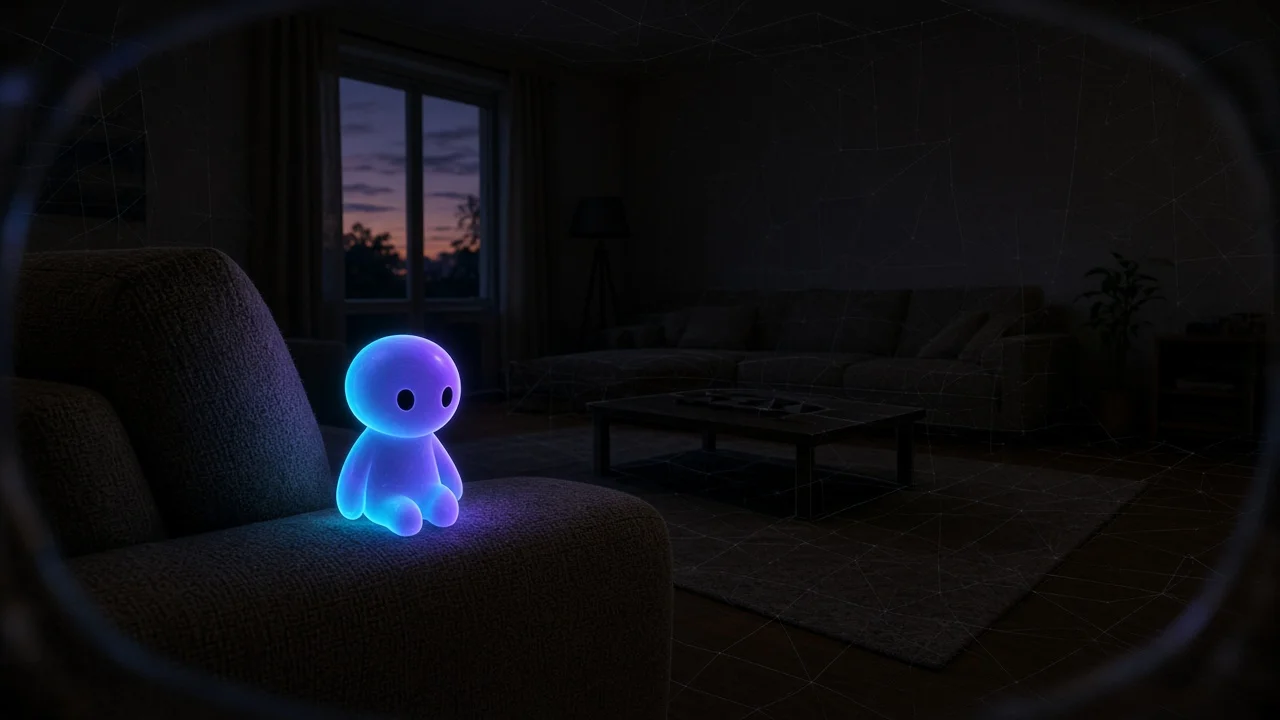
A companion that only floats in front of your face is just a chat window. To feel like it's really there, it needs:
- 6DoF tracking / SLAM, so it stays put when you move your head and walk around.
- Scene understanding: floors, tables, walls and seats, so it sits on the sofa instead of inside it.
- Occlusion and depth, so your coffee mug can hide its feet. This is still the weak spot on today's glasses.
- Persistent anchors, so it's still by the window tomorrow. Android XR already lets you pin apps to walls, and its WebXR supports anchors, hit testing and depth.
- Light estimation, so it doesn't glow like a sticker in a dim room.
- Optical see-through rather than camera passthrough. You see the real room at full fidelity and the character is the only thing that's rendered. The trade-off is that additive displays can't show true black and struggle in bright light.
Camera-based awareness also means the room is being mapped. Platforms handle this with permission prompts (Chrome on Android XR asks before any 3D mapping). It's worth knowing what a companion app keeps.
Our take
The desk boxes are a nice bridge, but the one-spot form factor caps them at "fancy figurine". Glasses with SLAM, anchors and a capable AI model already cover most of the list above. What's still missing is the companion itself: a persistent character with memory that knows where it lives in your flat. Grok had the personalities, XREAL has the room tracking, and Gatebox has ten years of character design. Whoever combines the three first defines the category. AR is where companions stop being apps and start being presence, and that's far more interesting than another VR headset.
Sources
- XREAL on X: Hatsune Miku with HoloModels on AURA (https://x.com/XREAL_Global/status/2117694188334514440)
- XREAL / PR Newswire: XREAL AURA launch, prices and markets (https://www.prnewswire.com/news-releases/xreal-aura-launches-as-the-first-wired-xr-glasses-powered-by-android-xr-302921776.html)
- 9to5Google: Aura reservations and Europe "soon after" (https://9to5google.com/2026/06/16/xreal-aura-android-xr-reservations-games/)
- Animates on X: Sony XYN collaboration, pre-orders (https://x.com/animates/status/2115293025694073297)
- Sony XYN: ELF-MN1 compatible apps, incl. Animates (https://xyn.sony.net/en/developer/others/spatial-reality-display-mini/app_selections)
- Sony Japan: ELF-MN1 product page (https://www.sony.jp/spatial-reality-display/products/ELF-MN1/) and supply notice (https://www.sony.jp/spatial-reality-display/whatsnew/20261030.html)
- Razer: Razer AVA (https://www.razer.com/razer-ava) and reservation terms (https://www.razer.com/concepts/project-ava/reservation)
- Gatebox: Gatebox3 (https://www.gatebox.ai/gatebox3/en)
- Magica: Animates takes Grok's Ani avatar (https://magica.com/news/animation-inc-animates-ai-companion-grok-transition)
- Talking Timmy on Spectacles (https://www.reddit.com/r/Spectacles/comments/1qrogxr/talking_timmy/)
- Estuary Spectacles template (https://github.com/estuary-ai/estuary-snap-spectacles-template)
- Google: Android XR features update (https://blog.google/products-and-platforms/platforms/android/android-xr-immersive-features-update-april-2026/)
- ZeroXR: WebXR on XREAL Aura (https://0xr.space/m/how/does-xreal-aura-support-webxr)