Display Tech: How Smart Glasses Put Pixels in Front of Your Eyes
Every pair of smart glasses has to solve the same impossible-sounding problem: put a bright image in front of your eye without blocking the world, without a brick on your nose and without draining a battery the size of a sugar cube. The answer is always two parts working together: a tiny light engine that makes the image, and an optical combiner that bends it into your eye. Here is how the main options work, and what they cost you.
Part 1: Combiners (how the image reaches your eye)
Birdbath optics
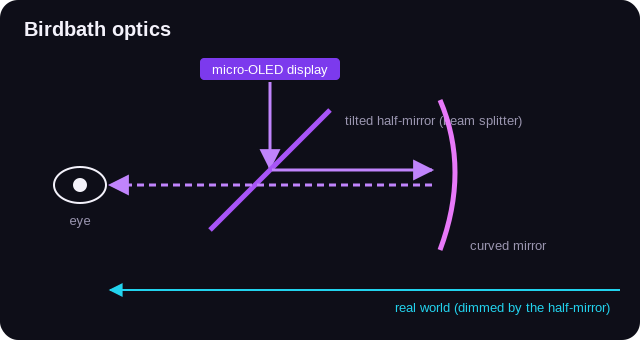
The micro-display sits above the lens and shines down onto a tilted half-mirror; a curved mirror in front of the eye reflects the image back, magnified, while you still see through it. It is simple, cheap to make and delivers rich colour and a big virtual screen.
- Pros: vivid image, high contrast, wide FOV for the price (roughly 45–57°).
- Cons: the half-mirror swallows a lot of real-world light, so the world looks dimmed; optics are thicker and front-heavy.
- Examples: XREAL One Pro (X Prism, a flatter birdbath variant), VITURE Luma Pro.
Waveguides
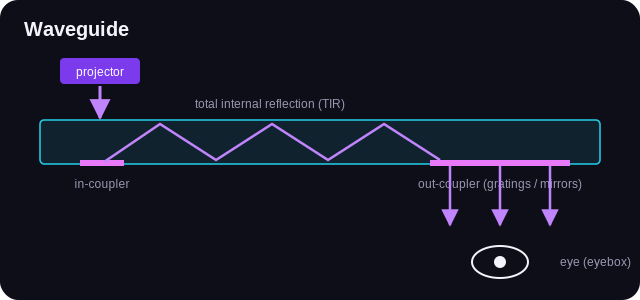
A thin glass plate carries light sideways from a projector in the temple via total internal reflection, then "out-couples" it toward the eye across a wider area (the eyebox). This is what makes glasses that look like normal glasses possible.
- Diffractive (surface relief gratings): nanoscale gratings bend light in and out. Thin and mass-producible, but prone to rainbow artefacts, colour non-uniformity and low efficiency, so the engine has to be very bright. Examples: Rokid Glasses, RayNeo X3 Pro.
- Reflective (geometric): embedded partial mirrors slice and reflect the light. Better colour and efficiency, fewer rainbows, but harder to manufacture. Example: Meta Ray-Ban Display is widely reported to use this kind of design.
- Holographic: recorded holographic layers (volume gratings) do the bending. Can be very transparent and light but are wavelength-picky, so full colour is hard.
- Pros overall: high transparency (often 90%+), thin, glasses-like. Cons: small FOV today (roughly 20–50°), light losses that cost battery, and pricey yields.
Part 2: Light engines (how the image is made)
Micro-OLED (OLED-on-silicon)
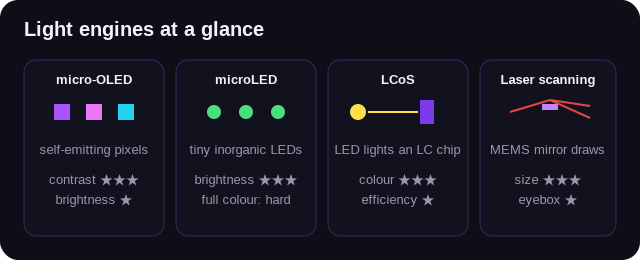
Self-emitting OLED pixels built directly on a silicon chip, giving tiny pixel pitches and perfect blacks. It dominates birdbath glasses and premium headsets.
- Pros: excellent contrast and colour, high pixel density. Cons: not bright enough to survive a waveguide's losses outdoors; burn-in/longevity limits.
- Examples: XREAL One Pro, VITURE Luma Pro, INMO Air3 (with waveguide), Brilliant Labs Halo, Apple Vision Pro (M5), Meta VR Glasses.
MicroLED
Microscopic inorganic LEDs, each a self-emitting pixel. They are extremely bright and efficient, which is exactly what lossy waveguides need, and they are the industry's long-term bet.
- Pros: thousands of nits, low power for sparse UIs, tiny engines, no burn-in. Cons: full colour is still hard and expensive (red is the problem child), so many products are monochrome green.
- Examples: Even Realities G2 and Halliday G2 (green), Rokid Glasses (green), RayNeo X3 Pro (full colour).
LCoS (Liquid Crystal on Silicon)
A reflective liquid-crystal chip modulates light from a separate LED or laser source, like a tiny projector. Mature, cheap and good with full colour.
- Pros: bright, full colour, high resolution, proven supply chain. Cons: needs illumination optics (more bulk), always-on light source wastes power on mostly-black AR content, weaker contrast.
- Examples: Snap SPECS; Meta Ray-Ban Display (full-colour micro-projector, widely reported as LCoS).
DLP (Digital Light Processing)
Millions of tiny tilting mirrors flip light on and off thousands of times per second. Rare in today's consumer glasses (no model in our database uses it), but common in pico projectors and some enterprise headsets.
- Pros: fast, bright, robust. Cons: bigger engine, colour-sequential "rainbow" effects, power hungry.
Laser beam scanning (LBS)
A MEMS mirror sweeps red, green and blue lasers across the combiner (or the retina) line by line, drawing the image instead of lighting a panel. Microsoft's HoloLens 2 and the discontinued North Focals used it.
- Pros: tiny engine, always in focus, very bright, only lights what it draws. Cons: small eyebox, speckle and resolution limits, laser safety engineering.
And then there are glasses with no display at all
AI glasses like Ray-Ban Meta (Gen 3) and Solos AirGo V2 skip optics entirely: camera, microphones, speakers and an assistant. That buys normal weight, normal lenses and much longer battery life, at the cost of anything visual. Privacy note: the camera is signalled by a recording LED, which only helps if people around you know what it means.
Our take
Right now you pick two of three: bright, wide, or normal-looking. Birdbath + micro-OLED wins for movies on a virtual screen; waveguide + microLED wins for all-day heads-up info. Full-colour microLED on a good waveguide is the combination everyone is racing toward, and the first maker to ship it at a sane price and weight will set the template.
Sources
- Wikipedia: Waveguide (optics) — https://en.wikipedia.org/wiki/Waveguide_(optics)
- Wikipedia: Liquid crystal on silicon — https://en.wikipedia.org/wiki/Liquid_crystal_on_silicon
- Wikipedia: Digital Light Processing — https://en.wikipedia.org/wiki/Digital_Light_Processing
- Wikipedia: MicroLED — https://en.wikipedia.org/wiki/MicroLED
- Wikipedia: Virtual retinal display (laser scanning) — https://en.wikipedia.org/wiki/Virtual_retinal_display
- Wikipedia: Head-mounted display — https://en.wikipedia.org/wiki/Head-mounted_display
- Meta Ray-Ban Display — https://www.meta.com/ai-glasses/meta-ray-ban-display/
- Snap Specs — https://newsroom.snap.com/introducing-specs-augmented-reality-glasses
- XREAL One Pro — https://www.xreal.com/one-pro
- VITURE Luma series — https://www.viture.com/academy/xr-glasses/luma-series
- RayNeo X3 Pro — https://www.rayneo.com/products/x3-pro-ai-display-glasses
- Brilliant Labs Halo — https://brilliant.xyz/products/halo
- ENGO 3 — https://us.engoeyewear.com/products/engo-3
- Apple Vision Pro (M5) specs — https://support.apple.com/en-us/125436
- Meta AI glasses announcement (Sep 2026) — https://about.fb.com/news/2026/09/introducing-ray-ban-meta-audio-glasses-new-styles-plus-muse/
- Even Realities G2 specs — https://support.evenrealities.com/hc/en-us/articles/13499229138959-Specs
Compare real devices in the device database.