
Review Check: XREAL AURA, a stunning screen still waiting for its software
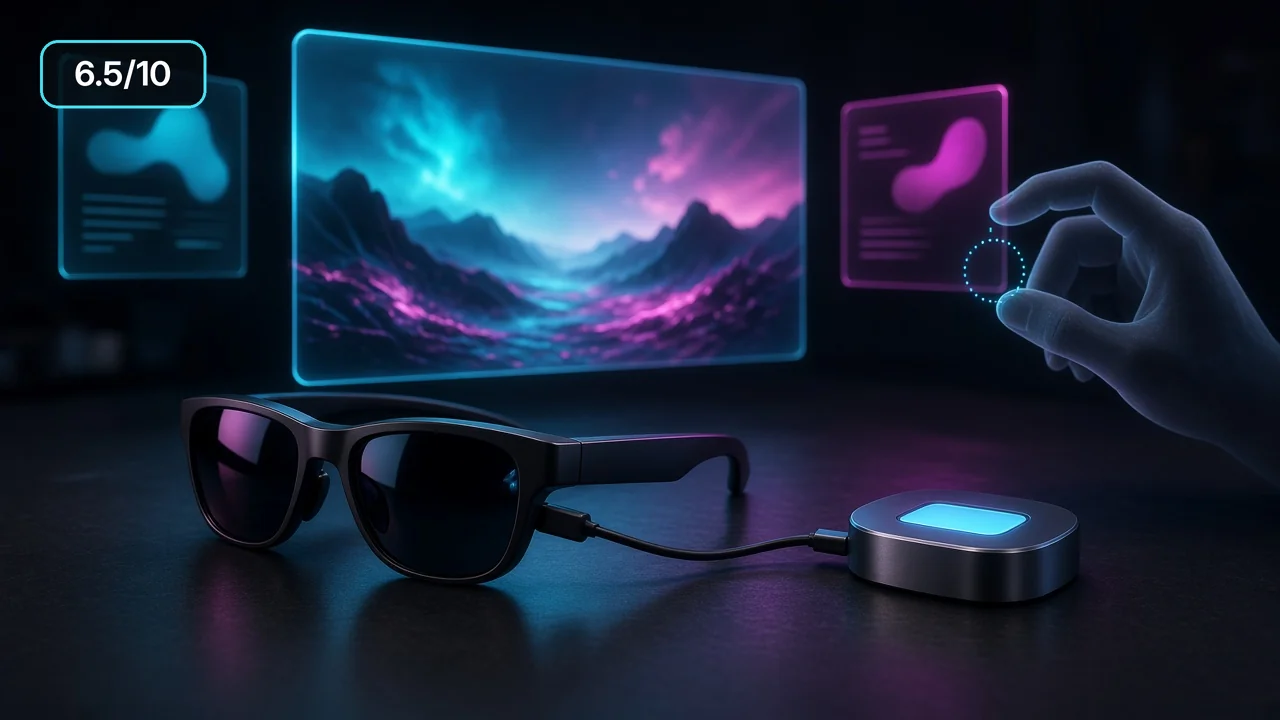
Two 1200p micro-OLED screens, a 70° field of view and a full Android XR computer, all in glasses that weigh 95 g. The XREAL AURA has been shipping for a week, and the first verdicts are in. The hardware wows almost everyone. Pinching your way around Android XR? That's where people start sighing.
This is an early Review Check: we read and watched the first published reviews and hands-ons, plus what early owners are posting, and summed them up. We did not test the glasses ourselves. The AURA has only been out since 17 November, so long-term reports don't exist yet.
Model page: /models/xreal-aura
The specs that matter
From our database: Sony micro-OLED with X Prism optics, 1920×1200 per eye, 120 Hz, up to 1,050 nits and a 70° field of view, with electrochromic dimming in five levels. The glasses (95 g) carry an XREAL X1S coprocessor, two tracking cameras plus a high-res camera with privacy LED, 6DoF and hand tracking, and Bose-tuned speakers. Everything else lives in the wired puck: Snapdragon Reality Elite, 12 GB/256 GB or 16 GB/512 GB, a 4,455 mAh battery, Wi-Fi 6E, Bluetooth 5.3 and DisplayPort-in. Price: $1,279 / $1,499 in the US, with a launch offer of $1,099 / $1,299 through December 2026. Shipping to the US, Canada, Japan and South Korea.
What reviewers love
The display is the headline. Every review we read praises the screens: sharp, bright, noticeably better than earlier XREAL glasses. A movie on a giant virtual screen with the dimming turned up is the moment that sells it.
A real computer on your face. Several testers wrote big chunks of their reviews with the AURA as their monitor, mirroring a laptop by cable or wirelessly. Because the lenses are see-through, you never lose the room, and that's exactly what one reviewer kept coming back to.
The puck is clever. Its front is a touchpad, so when gestures fail, you grab a mouse pointer. More than one tester ended up using it most of the time. Gemini integration also gets good marks: letting the AI see your screen and help out feels genuinely useful.
What keeps tripping them up
Controls. Hand tracking ranges from "pretty good in good light" to "hit or miss". Without eye tracking, small targets and typing are a chore, and in dim rooms tracking simply stops.
Android XR feels early. Apps crash, native XR apps are few, and much of the OS feels like phone Android floating in space. Several reviewers say it's mainly for developers right now.
Heat and the cable. The puck gets warm and is meant to stay out of a tight pocket. Testers measured roughly three to five hours depending on what you do.
What early buyers say
Owners are a mixed but busy crowd. Developers are thrilled: WebXR pages run unchanged, sideloading your own apps works, and hackathon projects popped up within days. One owner tested travel mode on a highway and found the screen rock-steady. The complaints are more specific: Netflix missing from the Play Store, the 3D mode older XREAL glasses had missing when the glasses run without the puck, pinches not registering, and one Founder's Edition puck with a cracked touchpad after a few days. A few pre-order customers are also puzzling over the shipping order. On VR, one early user put it nicely: thanks to the field of view, it still feels like looking into a box rather than stepping into a world.
Pros and cons
Pros: best-in-class display for glasses, see-through mixed reality, very light glasses, puck touchpad as fallback, full Android app library, works as plain display glasses too.
Cons: inconsistent hand tracking and no eye tracking, unstable and thin Android XR, warm puck plus cable, $1,279 regular price, some streaming apps missing.
My take: 6.5/10
The AURA is the most convincing glasses-shaped Android XR device so far, and the hardware is ready before the software is. The scores so far run from 6/10 to 4.5/5, which tells you how much depends on what you want: as a portable giant monitor it's excellent, as a "Vision Pro on your nose" it's a promising beta.
Worth it if you develop for Android XR, or you want the sharpest portable big screen with a bit of spatial computing on top and can grab the $1,099 launch price. Skip it if you mainly want movies and a virtual monitor (the cheaper XREAL One Pro does that) or if you expect polished, gesture-only control.
Sources
- https://www.engadget.com/2320945/xreal-aura-review/
- https://www.wired.com/review/xreal-aura/
- https://www.androidheadlines.com/xreal-aura-review
- https://9to5google.com/2026/11/17/xreal-aura-review-android-xr-glasses/
- https://www.tomshardware.com/peripherals/wearable-tech/xreal-aura-review
- https://www.tomsguide.com/computing/smart-glasses/i-tested-the-xreal-aura-glasses-for-2-weeks-amazing-displays-and-immersive-spatial-computing-let-down-by-a-lack-of-apps
- https://www.techradar.com/computing/virtual-reality-augmented-reality/xreal-aura-wired-android-xr-glasses-review
- https://www.howtogeek.com/xreal-aura-review/
- https://www.youtube.com/watch?v=C57PZSoCcvg
- https://x.com/Tks_Yoshinaga/status/2124769886329278660
- https://x.com/xRyooTA/status/2124705270442213842
- https://x.com/saji8k/status/2122924469744521536
- https://x.com/jaydensbest/status/2124303075859153048
- https://x.com/jaydensbest/status/2123614147468493104
- https://x.com/wakufactory/status/2124357885958500514
- https://www.xreal.com/aura
- https://us.shop.xreal.com/products/xreal-aura