Why Smart Glasses Specs Matter
"Immersive," "all-day," and "crystal clear" are not specs — they are adjectives. The numbers underneath decide whether a pair will bruise your nose or disappear on your face.
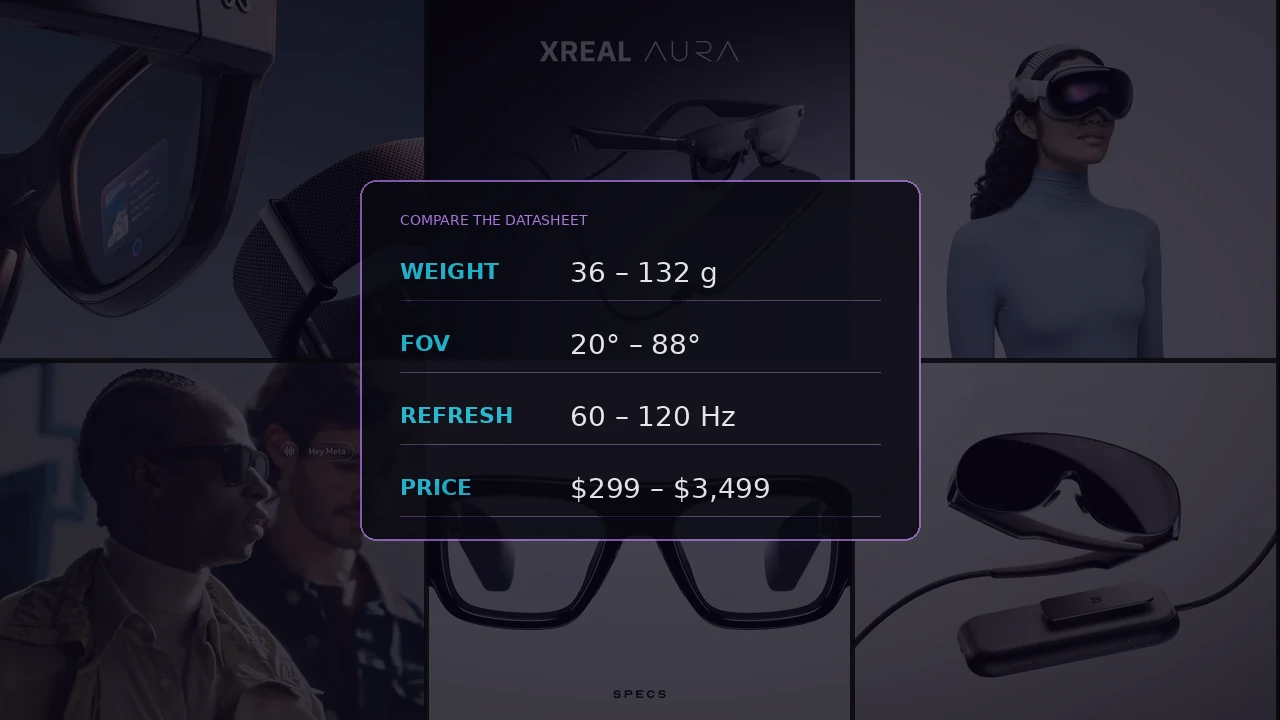
Weight is the first filter. In our catalog, the Even Realities G2 sits at 36 g, the ENGO 3 at 38.5 g, and the Halliday G2 and Rokid Glasses at 49 g. Move up to display-heavy glasses and the gap shows: Meta Ray-Ban Display is 69 g, RayNeo X3 Pro 76 g, VITURE Luma Pro 79 g, XREAL One Pro 87 g. Standalone AR gets heavier still — Snap SPECS lists 132 g (47 mm size). That spread is the difference between commuting wear and demo-session wear.
FOV is the marketing favorite, and the easiest to misread. Meta Ray-Ban Display publishes 20° for a monocular HUD; Halliday G2 25.2°; Even G2 27.5°; RayNeo X3 Pro 30°; INMO Air3 36°; VITURE Luma Pro 52°; XREAL One Pro 57°; XREAL AURA 70°; Meta VR Glasses 88° diagonal. A 20° monocular glance and an 88° VR canvas are different jobs — comparing them as "bigger FOV = better glasses" erases the product class.
Resolution and refresh decide text and motion. Catalog examples: Meta Ray-Ban Display at 600×600 monocular / 90 Hz; Even G2 at 640×350 / 60 Hz; RayNeo X3 Pro at 640×480; XREAL One Pro at 1920×1080 per eye / 120 Hz; VITURE Luma Pro and XREAL AURA at 1920×1200 per eye / 120 Hz; Meta VR Glasses at 2412×2288 per eye / 120 Hz; Apple Vision Pro (M5) lists 23 million pixels total with up to 120 Hz. Panel count without optics context is still incomplete — but blank marketing copy is worse.
Battery lives in the detailed spec rows, not the headline table. Where makers publish it, we keep it: Meta Ray-Ban Display up to 6 h mixed use (about 30 h with the case), Ray-Ban Meta Gen 3 up to 9 h, Snap SPECS up to 4 h mixed (20 h with case), Even G2 about 2 days regular use, Halliday G2 up to 12 h, ENGO 3 up to 24 h. If a row is empty, we leave it empty — no invented "all-day."
Price and availability close the loop. Catalog MSRPs we currently list include Solos AirGo V2 ~$299, Brilliant Labs Halo ~$399, ENGO 3 ~$400, Ray-Ban Meta Gen 3 ~$449, VITURE Luma Pro ~$499, Even G2 / Halliday G2 ~$599, Meta Ray-Ban Display ~$799, INMO Air3 ~$1,099, Meta VR Glasses ~$1,300, RayNeo X3 Pro ~$1,299, Snap SPECS ~$2,195, Apple Vision Pro (M5) ~$3,499. Some entries still have no firm USD (XREAL AURA lists a ceiling in notes; XREAL One Pro price appears in shop notes). Availability notes — shipping windows, regions — sit in the per-model rows when we have them.
Marketing blurbs hide tradeoffs on purpose: wide FOV often costs weight or battery; a light HUD often means a small panel; a low sticker price may mean tethered compute or no display at all. Read the full row, not the hero sentence.
On ArcaneRefraction, every model page shows the core table (weight, FOV, resolution, refresh, price) plus keyed specs and a Source link when we have one. Unknown values stay as em dashes. Extra rows often include source_official, source_specs, and data_checked so you can see where a number came from.
Our take: FOV alone misleads more than any other single number. Match FOV to the job — notification HUD vs. cinema panel vs. spatial AR — then check weight and battery before you care who won the degrees contest.
Compare the live set on Models.