
XREAL AURA Gets Its First Google-Made Game, Still No Date for Europe
Google’s own game studio has made a game for see-through AR glasses. The catch for us: those glasses still have no launch date in Europe.
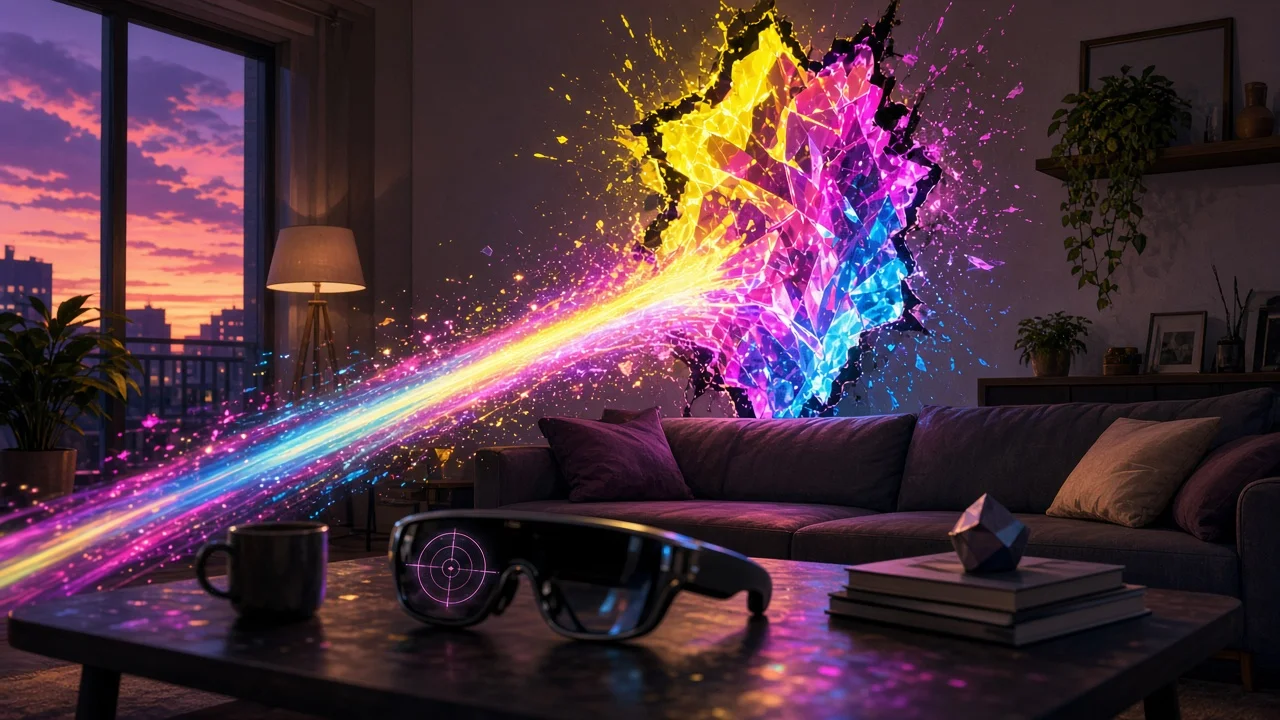
What Owlchemy announced. On 22 October 2026, Owlchemy Labs, the studio behind Job Simulator and Vacation Simulator, revealed Hyper Visor, an “original XR arcade blaster” arriving as a launch title for XREAL AURA. Google bought Owlchemy in 2017. The premise plays on the hardware itself: a “mysterious pair of living shades” reveals glowing fractures in reality hidden in your own room. You fire an energy stream straight from your hands to shatter targets, knock out bosses and seal the rifts. There are eight levels, each with its own targets, challenges and a boss guarding a rift, and every win powers up the visor for the final showdown. Hyper Visor will cost $1.99 on the Google Play Store.
The rest of the line-up. Owlchemy says Job Simulator, Vacation Simulator, Dimensional Double Shift and Inside [JOB] will also be available on AURA at launch. On Google Play, Job Simulator and Vacation Simulator currently cost $19.99 each, while Dimensional Double Shift and Inside [JOB] are free. Hyper Visor was not listed there yet when we checked on 23 October. Coverage of the reveal also names games from other studios for AURA, including Resolution Games’ Demeo, Odders’ Chess Club, nDreams’ Oh My Galaxy! and three titles from DB Creations.
A stage on your wall, not a full room takeover. Reports on the reveal describe Hyper Visor as more 2D than a fully immersive VR game, and the official screenshots show each level as a framed playfield hanging in front of a wall, with the room still visible around it. Owlchemy’s CEO, Andrew Eiche, pitches it as an entry point: “XREAL Aura is essentially a pair of shades, which makes XR far more approachable for anyone who may have been hesitant to put on a headset before.” So far Owlchemy names only AURA as the platform for Hyper Visor, while its older VR games already run on Samsung’s Galaxy XR headset through the same Play Store.
Our take: bright on purpose. AURA uses optical see-through displays, so the picture is laid over the real world. Glasses like this can add light but can’t take it away, which means black shows up as transparent and dark scenes melt into your living room unless you dim the lenses. A game built from saturated yellows, magentas and blues, with glowing rifts instead of dark space, works with that limit instead of fighting it. It looks less like a VR port and more like something designed for glasses. The $1.99 price fits too: it’s an easy first download on a device almost nobody owns yet.
The hardware: still no exact date. AURA costs $1,279 (12 GB RAM, 256 GB) or $1,499 (16 GB, 512 GB). XREAL says shipping begins “before the holidays” in the US, Canada, Japan and South Korea, but hasn’t named a day. Owlchemy’s own wording is that Hyper Visor arrives “when XREAL Aura launches.”
Europe is still waiting. In its 7 October pricing announcement, XREAL said more markets would follow in 2027, with timing to be announced. Its EU shop now has an AURA product page, but the FAQ still lists only the four launch countries and says dates for other regions are “still to be confirmed.” A Google-made launch game is a good sign for the platform, but for readers in Germany it’s still something to watch from the sidelines. More background: our AURA pricing post, Samsung’s glasses that also skip Europe and XREAL’s mystery computing kit at the FCC. We’ll update the AURA model page as soon as there’s a European date.
Sources
- Owlchemy Labs press release via Games Press: Hyper Visor reveal (22 Oct 2026)
- Road to VR: Google VR studio unveils Hyper Visor for XREAL Aura (22 Oct 2026)
- GamesBeat: Owlchemy Labs reveals Hyper Visor (22 Oct 2026)
- VR.org: Hyper Visor pricing and design for optical see-through (22 Oct 2026)
- Google Play: Owlchemy Labs developer page (checked 23 Oct 2026)
- XREAL via PR Newswire: AURA pricing and launch markets (7 Oct 2026)
- XREAL: AURA product page and FAQ
- XREAL EU shop: AURA shipping FAQ