
XREAL One Pro review: 57° FOV, an onboard X1 chip, and a price that still stings
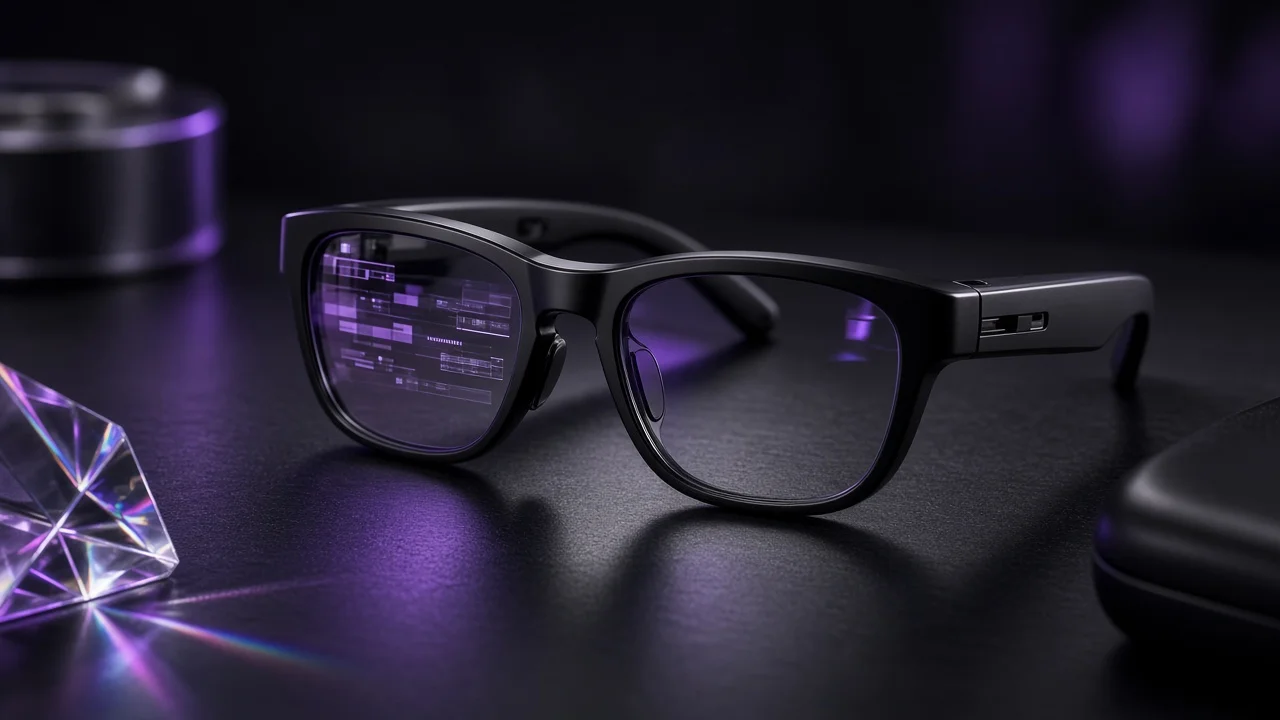
XREAL's One Pro is not an AI glasses product and not a mixed-reality headset. It is a tethered virtual monitor you wear: plug USB-C into a phone, Steam Deck, laptop or handheld, and a private 1080p-per-eye screen appears in front of you. Across Tom's Guide, Tom's Hardware and other coverage from mid-2025, the consensus is blunt. The picture, optics and Bose-tuned audio sit near the top of the display-glasses class — and so does the bill.
Model page: /models/xreal-one-pro
What it is
The One Pro ships as glasses plus a USB-C cable, nose pads, a protective case and a prescription-lens frame. There is no onboard battery and no built-in camera. Power and video come from the host over USB-C with DisplayPort Alt Mode. That keeps the frame light — about 87 g in XREAL's own comparison table — and puts every host that can push video over USB-C on the table: iPhone (DP Alt Mode), Android, Mac, Windows PC, Steam Deck, ROG Ally and similar handhelds.
Two hardware IPD sizes cover most faces: M (57–66 mm) and L (66–75 mm), with finer software tweaks on top. Getting the size wrong shows up as soft edges; reviews repeatedly flag measuring IPD before ordering.
Optional add-ons sit outside the glasses: Nebula software for multi-monitor desktops, Beam Pro for a fuller spatial OS, and the XREAL Eye clip-on camera (~$99) for photos, short video and 6DoF anchoring. The base unit itself stays a screen on your nose.
Display and optics
This is where the Pro earns its name. Instead of the chunkier triangular birdbath on the cheaper One, the One Pro uses XREAL's flatter X Prism engine — still a birdbath-family combiner, just much more compact (see /display-tech). XREAL claims the optic is about 40% smaller while opening the field of view to 57°, with a virtual image marketed up to roughly 171 inches.
Panels are Sony 0.55-inch micro-OLED, 1920×1080 per eye, up to 120 Hz, peak perceived brightness around 700 nits, and factory colour calibration aimed at ΔE < 3. Hands-on coverage calls out sharp text for productivity, low edge blur when IPD is set correctly, and strong immersion once electrochromic dimming is cranked up — useful on flights and for gaming when ambient light would otherwise wash the image out.
Three-level electrochromic tinting beats clip-on light shields: you dial how much of the room you still want to see. Direct sun still fights birdbath physics; this is indoor / cabin / evening glassware, not a beach reader.
Our database notes (checked 2026-10-06): brightness 700 nits, X Prism / Sony micro-OLED, 57° FOV, 120 Hz — matching the official comparison table and the reviews above.
Audio
Temple speakers carry a Sound by Bose tune. Coverage describes clearer dialogue and more balanced music than earlier Air-series arms, with enough volume for a quiet cabin or desk. Open-ear design still lets the room in; for trains, cafés or ANC immersion, people plug in earbuds anyway. That is a category trait, not a One Pro exclusive.
Tracking and fit
The onboard XREAL X1 chip is the other headline. It brings native 3DoF — rotation tracking so a virtual screen can stay anchored or gently follow your head — without needing a Beam adapter for basic spatial modes. XREAL quotes roughly 3 ms motion-to-photon latency in lab conditions. Modes covered in reviews and marketing include Anchor, Follow, Ultra Wide (a curved ultrawide virtual screen) and Side View for a smaller pinned panel while you still see the room. More on what 3DoF actually buys you: /tracking-sensing.
True 6DoF (walking around a world-locked screen) needs the optional Eye camera. Tom's Hardware found monocular SLAM usable as a demo but less steady than a Quest-class headset, and photo/video quality from the Eye mediocre in low light. Several reviews advise skipping the Eye until a stronger app story exists.
Fit: matte arms, Bose chambers, USB-C on the left temple, button cluster on the right. At ~87 g it is heavier than some Air-class frames (~75 g) and close to rivals in the same weight band. Prescription wearers need inserts; there is no built-in diopter dial.
Software and ecosystem
Out of the box the glasses act as a DisplayPort monitor. Nebula on Windows, macOS and Android adds multi-window / spatial desktop workflows. Beam Pro remains the optional compute brick for people who want a more self-contained spatial setup. Host compatibility is the practical strength: if the device already outputs video over USB-C, setup is usually plug-and-play, then set refresh to 120 Hz when the source allows.
Firmware has continued to add features after launch (including 3D-related unlocks promoted on the EU shop). Treat those as software extras on top of the same hardware, not a free hardware upgrade.
Price and availability (including Europe)
Pricing has moved around, so treat shop pages as live sources:
- EU shop (checked for this draft): often listed around €599 on sale against a higher regular (~€689), taxes included, free shipping / 30-day return framing on XREAL's storefront.
- US: launch narrative in mid-2025 reviews was roughly $599 preorder rising toward $649 general availability; later retail and sale tags have varied.
- Our /models/xreal-one-pro entry still leaves price_usd null on purpose because XREAL's own shops showed mixed figures (US sale vs regular; EU around the mid-€500s on 2026-10-06). Prefer the live shop over any single archived number.
Europe: XREAL's EU storefront ships the One Pro into EU markets; Glaiss and similar roundups note French-warehouse style fulfilment with no import theatre for EU buyers — still verify destination and VAT on the checkout you actually use. Warranty length can differ by region (shop copy vs local consumer law).
Who it is for
Buy it if you want one of the widest, sharpest birdbath pictures in glasses form, native 3DoF without a Beam, Bose audio, and you already live on USB-C hosts (handheld PC, MacBook, phone with DP Alt Mode). Long flights, hotel desks and couch gaming are the use cases that keep showing up in positive coverage.
Skip or wait if you mainly want a cheap portable monitor (the non-Pro One or discounted rivals cover that), you need outdoor brightness as a daily driver, you want camera-first AI glasses, or you are about to buy into the newer brightness class below.
Looking ahead: XREAL 1 Pro+
In mid-October 2026 XREAL started selling the XREAL 1 Pro+ — same body recipe and X1 / 57° / 1080p-per-eye core, with peak brightness raised to about 1,200 nits, AI HDR and picture modes, faster 2D-to-3D conversion, and a redesigned nose pad. US list is widely reported at $599; EU shop pricing has been reported around €649. Chip, FOV and tethered nature are unchanged.
A side-by-side of One Pro vs 1 Pro+ belongs on this site once more independent hands-on coverage settles the brightness and fit claims. Until then, new buyers who care about bright rooms should weigh the Plus; existing One Pro owners should not assume they need to upgrade on paper alone.
Bottom line
The One Pro is still the clearest argument for paying Pro money in XREAL's display-glasses line: wider FOV, flatter optics, X1 spatial modes, Bose audio. It is also still a cable-powered monitor on your face at a premium that only makes sense if you will use that monitor a lot. Specs and live price live on the model page; optics background on /display-tech; tracking vocabulary on /tracking-sensing.
Sources
- XREAL One Pro (official) — https://www.xreal.com/one-pro
- XREAL EU shop — One Pro — https://eu.shop.xreal.com/products/xreal-one-pro
- Tom's Hardware — Xreal One Pro review (18 Jun 2025) — https://www.tomshardware.com/peripherals/wearable-tech/xreal-one-pro-review
- Tom's Guide — Xreal One Pro AR glasses review — https://www.tomsguide.com/computing/vr-ar/smart-glasses/xreal-one-pro-ar-glasses-review
- UploadVR — Xreal One announcement / X1 3DoF context — https://www.uploadvr.com/xreal-one-announcement-preorders/
- Engadget — Xreal One Series announcement — https://www.engadget.com/ar-vr/xreals-new-one-series-ar-glasses-use-usb-c-to-connect-with-nearly-any-device-191221387.html
- 9to5Google — XREAL 1 Pro+ upgrades / $599 (15 Oct 2026) — https://9to5google.com/2026/10/15/xreal-1-pro-plus-upgrades-price/
- Road to VR — XREAL 1 Pro+ release / price (cited in our model DB) — https://roadtovr.com/xreal-1-pro-plus-release-date-price/
- ArcaneRefraction model entries — /models/xreal-one-pro, /models/xreal-1-pro-plus